On this page 11 sections
- The Interactive Gambling Act 2001
- ACMA Enforcement: Blocking, Mirror Domains and Your Balance
- The June 2024 Ban on Credit Cards and Digital Currency for Licensed Wagering
- The Gambling Reform Act 2026: What Changes on 1 January 2027
- BetStop: What It Covers and What It Doesn't
- AUSTRAC and the Exchanges You Buy Bitcoin From
- Offshore Casino Licences: Curaçao, Anjouan, Kahnawake
- Operator Terms and Australian Access
- Tax on Gambling Winnings and Crypto in Australia
- Record-Keeping for Crypto Gambling
- Are Crypto Casinos Legal? FAQs
The short answer pleases nobody. Are crypto casinos legal in Australia? Offering an online casino to people in Australia is illegal, whether it takes Bitcoin, USDT or a bank card. The law is written to catch the operator, not the person playing.
That gap is where most of the confusion sits. Nothing in the rules turns an offshore site into an approved or protected option, and the Australian Communications and Media Authority (ACMA) says plainly that Australians who use illegal services risk losing their money.
Below is what the rules actually say, checked against government sources on 19 October 2026: the Interactive Gambling Act 2001 (IGA), ACMA blocking, the 2024 crypto payment ban, the 2026 reform, BetStop, AUSTRAC, offshore licences and tax. If you searched for "crypto casino legal australia" or "bitcoin casino legal australia", this is the long answer. It is general information, not legal or tax advice.
In short
- Anyone asking "are crypto casinos legal" in Australia gets a no: offering an online casino is illegal, whatever the payment method.
- ACMA has blocked 1,822 illegal gambling and affiliate websites since its first request in November 2019.
- BetStop binds licensed Australian wagering providers, so it will not block an offshore crypto casino account.
The Interactive Gambling Act 2001
ACMA's own summary is blunt: the Interactive Gambling Act 2001 makes it illegal for gambling providers to offer some online services to people in Australia. The banned list covers online casinos, in-play sports betting, sports betting services without an Australian licence, and betting on the outcome of a lottery.
The same page says banned services must not be advertised in Australia. ACMA's consumer page spells out what counts, listing slots (pokies), casino-style games like poker, blackjack and roulette, and scratchies among illegal online services.
So are crypto casinos legal under the IGA? The coin changes nothing. A site offering pokies (online slots) and live dealer games to Australians is a prohibited service whether the deposit arrives as A$ or as BTC.
Is online gambling legal in Australia at all? Licensed wagering is: ACMA publishes a register of Australian-licensed interactive wagering providers. Online casino games are the category with no licensed local option.
Why the Act targets operators
The wording matters. ACMA frames the offences around providing and advertising these services. Its quarterly report for late 2025 puts it in one line: it is an offence to provide or advertise these types of services to customers in Australia.
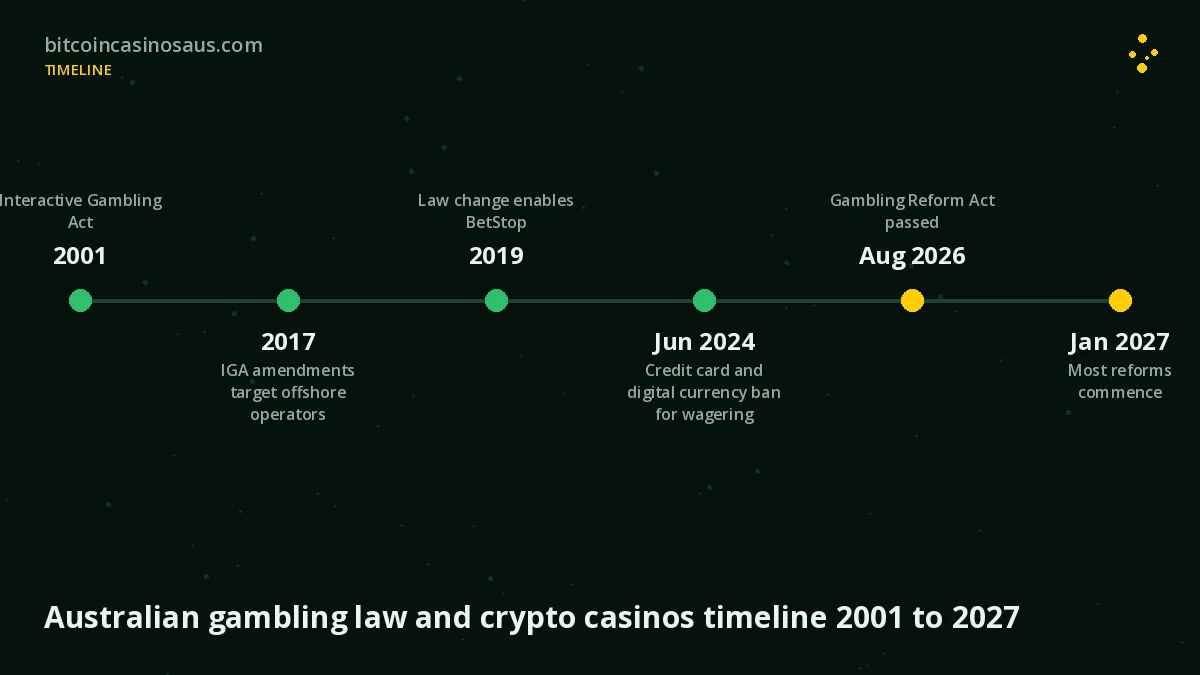
The 2017 amendments added tools aimed at companies, including the power to refer the directors and principals of offending companies to the Australian Border Force. We found no ACMA page that describes a penalty for a player who simply uses an offshore casino.
ACMA Enforcement: Blocking, Mirror Domains and Your Balance
ACMA asks internet service providers to block websites under section 313 of the Telecommunications Act 1997. Its triggers include providing prohibited services such as online casinos and online slot machines, providing unlicensed wagering, and publishing ads for either.
Blocking is ACMA's practical answer to the question "are crypto casinos legal": it treats them as illegal services and cuts access. The count keeps climbing. ACMA's 24 September 2026 update says 1,822 illegal gambling and affiliate websites have been blocked since its first request in November 2019. Over 230 illegal services have left the Australian market since enforcement of the 2017 rules began.
Mirror domains
Blocking a domain rarely ends a brand. In October to December 2025 alone, ACMA blocked 133 websites and said the list includes alternate sites set up to evade the blocks. The same brand names come back on numbered or reworded domains, and the list shows more than a dozen variants of a single brand.
Some blocked sites copy licensed names. In July 2026, ACMA blocked Lightning-bet.com for imitating the licensed LightningBet service, alongside affiliate marketing sites.
What happens to a balance on a blocked site
ACMA's answer is not reassuring. It warns that once a site is blocked, you may not be able to log in and access your existing account. It also lists real complaints: winnings withheld, operators closing or moving with player money, and unauthorised withdrawals from bank accounts.
According to that same page, Australian regulators will not help you recover money from an illegal service. ACMA's suggested options are independent legal advice, a complaint to the Australian Competition and Consumer Commission, or contacting the operator's licensing authority. Treat any crypto balance on an offshore site as money that could become unreachable overnight.
The June 2024 Ban on Credit Cards and Digital Currency for Licensed Wagering
The Interactive Gambling Amendment (Credit and Other Measures) Act 2023 received Royal Assent on 11 December 2023. Its payment provisions commenced six months later, on 11 June 2024.
The Act says certain interactive wagering services must not accept or offer to accept payment using credit cards and digital currency. The government's credit card ban page gives cryptocurrency as the example of digital currency, names ACMA as the body overseeing compliance, and says companies that fail to enforce the ban may face fines of up to A$247,500.
Most coverage loses two points. First, the ban binds Australian online wagering providers, the legal betting sector, so a licensed Australian bookmaker cannot take your BTC. Second, it does not make offshore crypto casinos legal by implication: online casinos were already prohibited, so they never had a lawful crypto option to lose.
The Act also requires a review of the ban once it has run for two years. The government says that review will happen after June 2026.
The Gambling Reform Act 2026: What Changes on 1 January 2027
On 19 August 2026, Parliament passed the Interactive Gambling Amendment (Gambling Reform) Bill 2026. ACMA says most of the reforms commence on 1 January 2027, and the Department of Infrastructure confirms ACMA will monitor and enforce them.
ACMA's list of changes, in plain terms:
- Advertising: restrictions on gambling ads on TV, radio, online and in sports venues, plus a global opt-out register for gambling advertising.
- Inducements: limits on direct marketing of inducements to new account holders for their first 14 days, to people who left BetStop in the last 3 months, and to any customer identified as at risk of harm.
- Affiliate commissions: a ban on commissions to staff or affiliates based on customer activity.
- Takedown powers: stronger enforcement against illegal gambling services, including the ability to take down advertisements and the services themselves.
- BetStop: a strengthened National Self-Exclusion Register.
- Lotteries: measures against harmful and emerging online lottery products.
Two cost recovery bills passed the same day, so wagering companies will fund BetStop promotion, the inducement rules and the opt-out register. For anyone asking "are crypto casinos legal after 2027?", the honest reading is that the reform adds enforcement against offshore sites and opens no door. ACMA says it will publish more detail before commencement, and we will re-check this section then.
BetStop: What It Covers and What It Doesn't
BetStop is the National Self-Exclusion Register. ACMA says it lets you exclude yourself from all Australian licensed online and phone wagering services in a single step, roughly 150 providers.
The rules are firm. You can exclude for a minimum of 3 months and up to a lifetime, extend at any time, but never shorten the period. Removal cannot be requested in the first 3 months, and it needs a statutory declaration confirming you received counselling or advice from a qualified counsellor, psychologist or doctor.
What BetStop does not cover is the part most pages skip. It binds licensed Australian wagering providers. An offshore crypto casino is not one of them, so registering will not close or block an account there. If you use BetStop, pair it with device-level blocking software and the casino's own self-exclusion tool.
AUSTRAC and the Exchanges You Buy Bitcoin From
A common mix-up runs like this: buying Bitcoin is legal, so are crypto casinos legal too? They are not, and the two questions sit under different laws. Buying Bitcoin in Australia is a regulated activity, not a grey one. AUSTRAC says all virtual asset businesses must be registered before they can offer these services in Australia, and it has regulated these providers since 2018.
In April 2026, as part of expanded anti-money laundering laws, Australia renamed digital currency exchange (DCE) providers as virtual asset service providers (VASPs). AUSTRAC's VASP register went public in June 2026, so you can check an exchange before you send it a cent.
Registration covers the exchange, not what you do with the coins afterwards. Registered providers must meet Australia's AML/CTF obligations, and the ATO runs a crypto data-matching program using data from designated service providers. Expect the trail from exchange to casino deposit to be visible, whatever a casino's marketing says.
Offshore Casino Licences: Curaçao, Anjouan, Kahnawake
People often ask: are crypto casinos legal if they hold an offshore licence? No. No offshore licence makes an online casino lawful to offer in Australia. What a licence can give you is a regulator with some leverage over the operator, and that leverage varies a lot. A bitcoin casino license is worth exactly what its complaint route is worth to you.
| Licence | Regulator | Player disputes | What it means for Australians |
|---|---|---|---|
| Curaçao | Curaçao Gaming Authority, under the National Ordinance on Games of Chance (LOK), in force since 24 December 2024 | The CGA says it does not handle individual complaints and cannot order an operator to compensate a player; complaints feed its supervision only | No one mediates your dispute |
| Anjouan | Anjouan Gaming, under the Anjouan Offshore Financial Authority, Union of the Comoros | Complain to the operator first (30-day response), then to an approved ADR provider; complaints from players in excluded territories fall outside the process | If Australia is excluded under the licence, the route is closed |
| Kahnawake | Kahnawà:ke Gaming Commission, Canada | Its regulations provide dispute resolution, with a full-time Dispute Resolution Officer | Offers permanent self-exclusion; funds deposited in breach go to charity |
Of the 11 brands we track, most cite an Anjouan licence: Qzino, Cybet, Rakebit, Thrill, Wild.io and CasinoCrypto. Jack lists Curaçao Gaming Authority licence OGL/2024/1562/1139. Betpanda's blog claims a Curaçao licence with no number shown, Winna names the Tobique Gaming Commission, and Cryptorino's terms cite Costa Rica with no licence number. None names Kahnawake.
Operator Terms and Australian Access
Operator terms do not answer "are crypto casinos legal"; they only show what each brand says about Australia. Below is what each operator's published terms said on 19 Oct 2026, pending confirmation with the operators. "Not named" does not mean permitted: most terms also bar players wherever online gambling is prohibited.
| Brand | What the official pages said | Source |
|---|---|---|
| Rakebit | Its own prohibited list does not name Australia; the Anjouan licence page linked from its footer lists Australia under Excluded Territories | terms |
| Thrill | Help centre lists Australia as not allowed; T&C 11.4 does not name it | help centre |
| Wild.io | T&C 2.6 lists Australia as a Restricted Country | terms |
| Cryptorino | Terms Section II lists Australia among countries that may not register | terms |
| Winna | Not confirmed: the full terms page would not load for us | supported countries |
| HyperLucky | Not confirmed: the terms list was cut off; the site also describes itself as "VPN Friendly" | ToS |
| Qzino | T&C cl. 3.5 lists Australia among jurisdictions where accounts may be restricted | See the brand's terms |
| Cybet | T&C cl. 4 does not name Australia ("including but not limited to") | See the brand's terms |
| Betpanda | A terms snippet and its blog list Australia; its help centre also suggests using a VPN | See the brand's terms |
| Jack | Terms s.3 bans only Russia, Belarus, Lithuania, Georgia, Ukraine, Latvia, Moldova (Australia not named) | See the brand's terms |
| CasinoCrypto | No country list; s.9 bars players where online or crypto gambling is prohibited | See the brand's terms |
A casino that suggests a VPN is telling you how it treats its own rules. Using one to get around a restricted-country clause usually breaches the terms, which gives the operator grounds to void winnings.
Tax on Gambling Winnings and Crypto in Australia
Crypto gambling tax in Australia has two separate layers: the gambling result, and the crypto you used to get there. Most players only think about the first.
Gambling winnings: hobby or business
The ATO's ruling IT 2655 says it will be rare for a punter to be carrying on a business of gambling, and that no Australian case has held a mere punter's winnings assessable. The flip side is that losses are not deductible either.
The Federal Court criteria quoted in that ruling decide the edge cases: whether the gambling is systematic, organised and businesslike, its volume and size, links to other business activity, and whether it is done mainly for profit or pleasure. The ruling also notes that gambling with a significant element of skill is more likely to have tax consequences.
Crypto: the CGT layer
The ATO says there are no special tax rules for crypto assets, and crypto held as an investment is a CGT asset. Its list of CGT events includes selling, swapping one coin for another, converting to Australian dollars, and buying goods or services with crypto.
That last item is why a casino deposit may itself be a disposal. The ATO has no page specific to casino deposits, so confirm the treatment with a registered tax agent. Australian residents who hold an asset for at least 12 months can cut the gain by 50% under the CGT discount. The ATO notes that CGT changes announced in the 2026 to 27 Federal Budget do not apply to Tax Time 2026.
Do not count on the personal use asset exemption. The ATO says crypto held as an investment is not a personal use asset, and exchanging crypto for Australian dollars before spending it usually rules the exemption out.
Worked example in A$
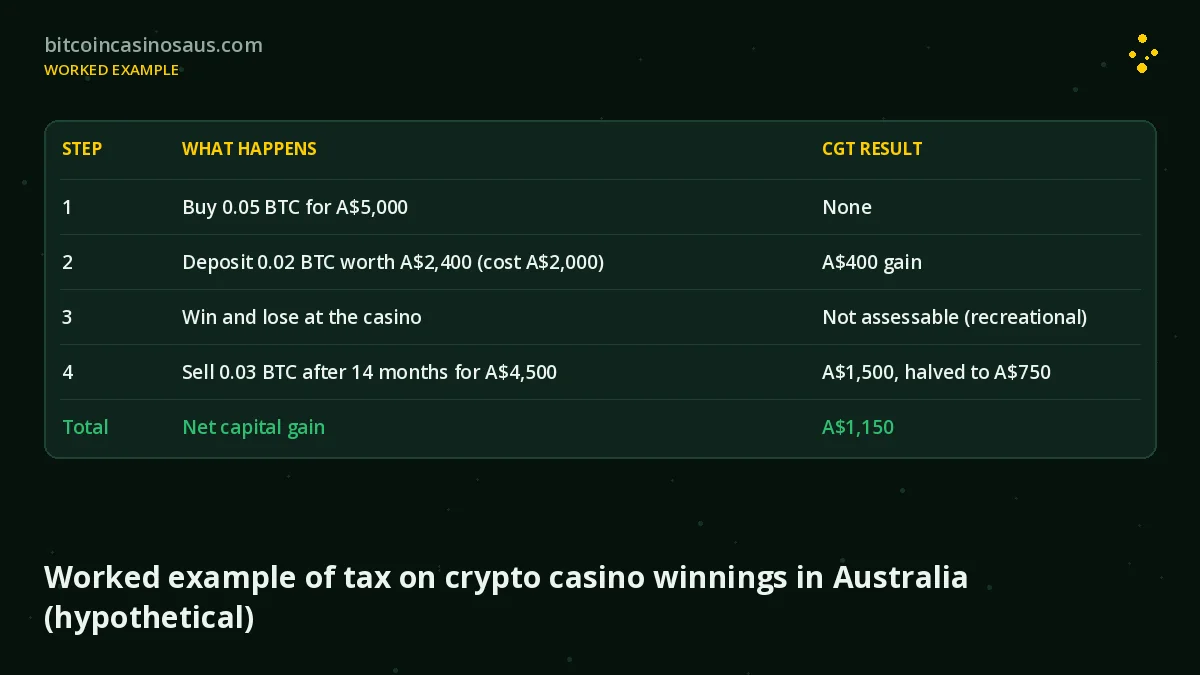
The figures below are hypothetical, for a recreational player who is an Australian resident, assuming the deposit counts as a disposal.
| Step | What happens | CGT result |
|---|---|---|
| 1 | Buy 0.05 BTC for A$5,000 | None (acquisition) |
| 2 | Two months later, deposit 0.02 BTC (cost base A$2,000) when it is worth A$2,400 | A$400 gain, no discount (held under 12 months) |
| 3 | Win and lose at the casino | Not assessable for a recreational player under IT 2655 |
| 4 | Hold the other 0.03 BTC (cost base A$3,000) for 14 months, then sell for A$4,500 | A$1,500 gain, halved to A$750 by the CGT discount |
| Total | Net capital gain added to assessable income | A$1,150 |
Coins you withdraw from a casino are the awkward part. The ATO has not published guidance on the cost base of crypto received as casino winnings, so that is a question for a registered tax agent, not a forum thread.
Record-Keeping for Crypto Gambling
The ATO's crypto record-keeping page says you must keep records of each crypto asset and every transaction. Its list includes:
- receipts when you buy, transfer or dispose of crypto
- the date of each transaction, what it was for and the other party (a crypto address is enough)
- exchange records, digital wallet records and keys
- the value in Australian dollars at the time of each transaction
- agent, accountant, legal and tax software costs.
Keep them for 5 years from the latest of when you made the records, when the transaction finished, or the year of the CGT event. The ATO also suggests exporting your transaction history at least every 3 months, and before closing any account.
For casino play, add the deposit address, the transaction hash for each deposit and withdrawal, and the A$ value on the day. A blocked offshore site will not send you a statement later.
Are Crypto Casinos Legal? FAQs
Are crypto casinos legal in Australia?
No, offering an online casino to people in Australia is illegal under the Interactive Gambling Act 2001, whatever the payment method. The offences target providers and advertisers. Paying in Bitcoin or USDT does not change the status of the service.
Can I be fined for playing at an offshore casino?
We found no ACMA page describing a penalty for players; the IGA's offences are framed around providing and advertising services. The real risk is financial: ACMA warns you may lose access to your balance if a site is blocked, and Australian regulators cannot help you recover it.
Do I pay tax on bitcoin casino winnings?
Usually not on the gambling result itself, because the ATO treats recreational gambling winnings as not assessable. The crypto is a separate matter: selling, swapping or spending it can trigger capital gains tax, and a casino deposit may count as a disposal.
Does BetStop cover crypto casinos?
No, BetStop covers Australian licensed online and phone wagering providers only. Offshore crypto casinos are not part of it, so pair BetStop with blocking software and each casino's own self-exclusion tool.
What changes on 1 January 2027?
Most of the Gambling Reform Act 2026 commences, bringing advertising limits, inducement limits and a ban on activity-based affiliate commissions. It also adds takedown powers against illegal services and strengthens BetStop. ACMA will publish more detail before commencement.
Is it legal to buy bitcoin in Australia?
Yes, buying Bitcoin is legal, and exchanges must be registered with AUSTRAC before offering virtual asset services. You can check an exchange on AUSTRAC's public register of virtual asset service providers, published in June 2026.

Bruce Mackinley
Founder · WSOP tournament player, Melbourne
Bruce plays professional poker in WSOP tournaments, deals poker, and runs every page on this site through the same checks: published withdrawal terms, bonus fine print and what each casino's own help pages actually say.