





On this page 13 sections
- What Provably Fair Means
- Server Seed, Client Seed and Nonce, Explained
- How to Verify a Bet Yourself
- Which Games Can Be Provably Fair
- What Provably Fair Doesn't Prove
- House Edge and Returns Over Time
- Blockchain Casinos and Decentralized Casinos
- Provably Fair Bitcoin Casinos vs RNG-Certified Games
- Why Fairness Checks Matter at Any Bitcoin Casino
- Provably Fair Game by Game
- Third-Party Verifier Tools and How to Use Them
- Red Flags in Provably Fair Claims
- Provably Fair FAQs
A fairness badge in a casino footer proves nothing on its own. Provably fair bitcoin casinos make a stronger promise. You can check every result yourself, with the same maths the casino used, and catch any change made after you placed the bet.
Almost nobody does that check. Players see the words "provably fair", assume the game is a good bet, and move on. Those are two different claims, and only one of them can be verified.
Below, we break down how the seed system works, run a real HMAC-SHA256 verification step by step, and set out what provably fair does not prove. That last part matters most.
In short
- Provably fair uses a server seed, a client seed and a nonce to fix each result before you bet.
- You can verify a bet yourself with HMAC-SHA256 and the formula on the casino's fairness page.
- A verified result says nothing about the house edge, payout speed or who runs the site.
What Provably Fair Means
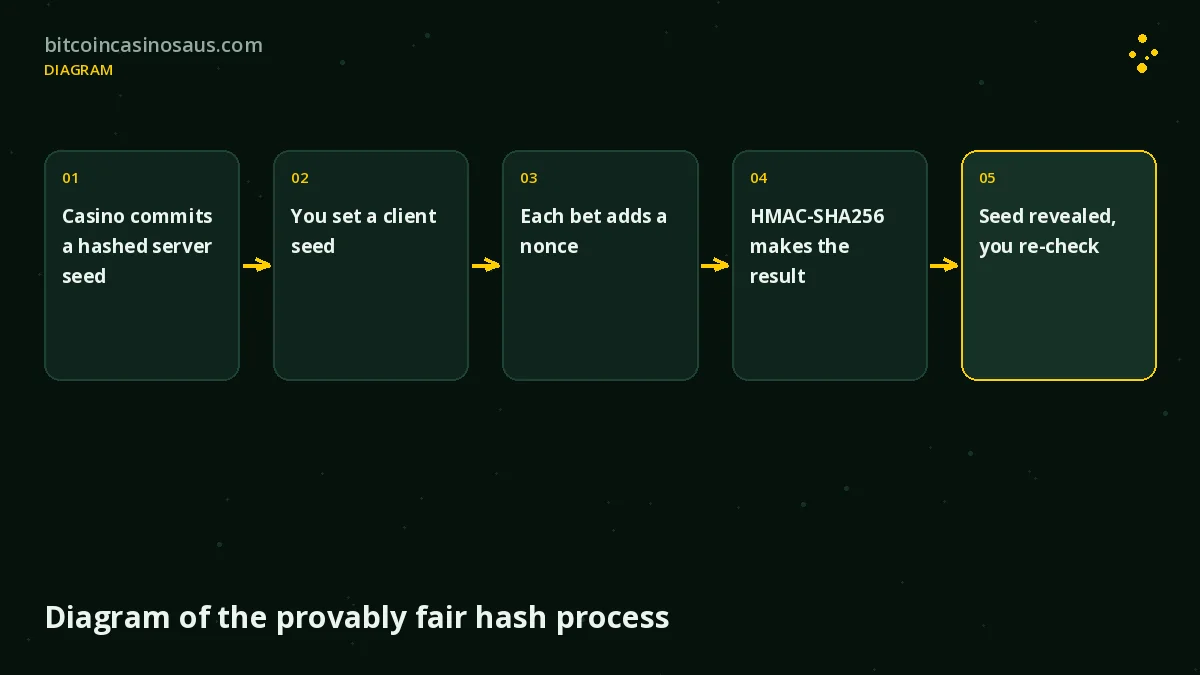
Provably fair is a method that lets you confirm a game result was fixed before you bet and was not altered afterwards. It works through cryptographic commitment. The casino locks in its secret before you play and shows you a fingerprint of that secret. Later it reveals the secret, so you can check the fingerprint matches.
Think of a sealed envelope. The casino writes a number, seals it, and hands you the envelope. You add your own number, play the round, then open the envelope. If the casino's number had changed, the seal would not match.
In practice, the "seal" is a SHA-256 hash. SHA-256 is a one-way function: the same input always gives the same 64-character output, and nobody can work backwards from the output to the input. Change one character of the input and the output changes completely. Bitcoin itself relies on SHA-256 for mining and block hashes.
The result is a real step up in transparency, but only for players who actually run the check.
Before you sign up at any of these provably fair bitcoin casinos, open the fairness or seed settings on one Original. Confirm three things: you can see the server seed hash before betting, you can change your client seed, and a verifier exists. Missing any of the three, the badge is decoration.
Server Seed, Client Seed and Nonce, Explained
Every provably fair result comes from three inputs. Each one has a job, and the system only works if all three are present.
Glossary: - Server seed: a random secret string generated by the casino. It stays hidden until you rotate it. - Server seed hash: the SHA-256 fingerprint of the server seed, shown to you before you bet. It is the casino's commitment. - Client seed: a string you control (or the site generates and you can edit). It stops the casino from picking a server seed that suits a known client seed. - Nonce: a counter that rises by one with each bet on the same seed pair, so every bet gets a fresh result. - SHA-256: a one-way hash function that turns any input into a fixed 64-character hex string. - HMAC-SHA256: SHA-256 applied with a secret key (here, the server seed) to a message (here, the client seed and nonce).
The order of events matters. The casino commits to its server seed first, by showing you the hash. You then set your client seed. Neither side can know the final result in advance, because it needs both seeds.
When you rotate seeds, the casino reveals the old server seed, issues a new hidden one, and resets the nonce. Only then can you verify the bets made on the old pair.
A client seed you cannot edit is a weak point, so change it to something of your own at least once per session.
How to Verify a Bet Yourself
The method below is the common HMAC-SHA256 pattern. Each casino publishes its own exact formula, so match your check to the game's fairness page. The numbers here are a real calculation on a hypothetical seed, not a casino record.
Step list:
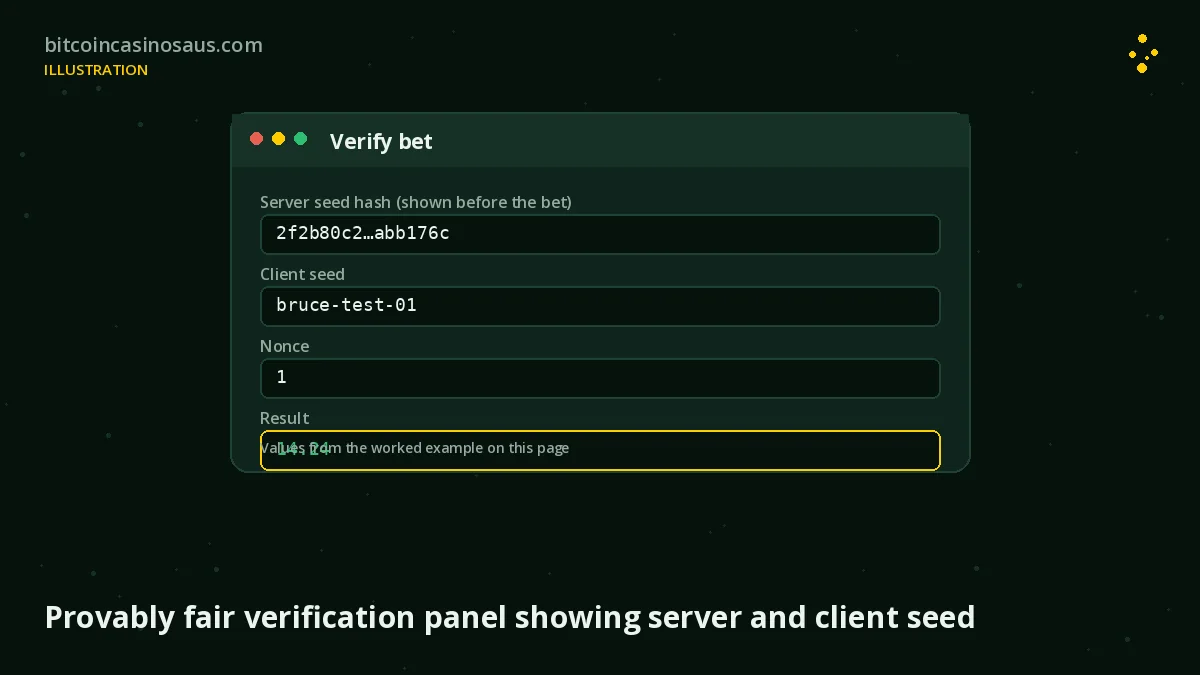
- Record the server seed hash shown in the fairness panel before you bet.
- Set your client seed and note it. In our example it is
bruce-test-01. - Place your bets and note the nonce for each one. Our first bet is nonce 1.
- Rotate the seed pair so the casino reveals the old server seed.
- Hash the revealed server seed with SHA-256 and confirm it matches the hash from step 1.
- Compute HMAC-SHA256 with the server seed as the key and
client_seed:nonceas the message. - Convert the hash into a result using the game's published formula.
- Compare your result with the casino's bet history.
The worked example
Say the casino showed this server seed hash before you bet:
2f2b80c285863da52f98ff5b33c38a0a55d16950cc81f14d258178842abb176c
After rotation, it reveals this server seed:
9f3c1a7e5b2d8f40c6e1a93b7d5f2e8c4a0b6d1e9f7c3a5b8e2d4f6a1c9b7e3d
Hashing that seed (as plain text) with SHA-256 returns exactly the hash above, so the casino did not swap its seed. Next, compute HMAC-SHA256 with the server seed as key and bruce-test-01:1 as the message:
2478cdcf051135e968919b58aa50579668cb5acbed91205208f27e03a82c008d
For a simple dice game scoring 0.00 to 100.00, one common formula works like this:
| Step | Calculation | Value |
|---|---|---|
| Take the first 8 hex characters | 2478cdcf | 2478cdcf |
| Convert hex to a whole number | 0x2478cdcf | 611,896,783 |
| Divide by 2 to the power of 32 | 611,896,783 / 4,294,967,296 | 0.142468... |
| Scale to 10,001 outcomes and round down | 0.142468 x 10,001 = 1,424.8 | 1,424 |
| Divide by 100 | 1,424 / 100 | 14.24 |
The roll for nonce 1 is 14.24. Run the same steps with nonce 2 (bruce-test-01:2) and the HMAC begins 70673227, which gives a roll of 43.91. If the casino's history shows the same two rolls, both bets check out.
You can run this yourself in Python with no extra installs:
import hmac, hashlib
server_seed = "9f3c1a7e5b2d8f40c6e1a93b7d5f2e8c4a0b6d1e9f7c3a5b8e2d4f6a1c9b7e3d"
print(hashlib.sha256(server_seed.encode()).hexdigest())
h = hmac.new(server_seed.encode(), b"bruce-test-01:1", hashlib.sha256).hexdigest()
roll = int(int(h[:8], 16) / 2**32 * 10001) / 100
print(h, roll)
Two details trip people up. Some casinos hash the seed as raw bytes decoded from hex rather than as text, and some read four bytes at a time across the hash to build several floats. A mismatch usually means the formula differs, so read the fairness page before you assume foul play.
Run this check once on each site you use. It takes five minutes, and you will know whether its verifier is real.
Which Games Can Be Provably Fair
Provably fair works on games the casino runs itself, where the result comes from one calculation. At provably fair bitcoin casinos, that means dice, crash, limbo, plinko, mines, keno, coin flip and hi-lo. These in-house Originals are where the seed system lives.
Most other bitcoin casino games cannot be provably fair in this sense. Third-party pokies run on the studio's own servers, and live dealer games depend on physical cards and wheels. Those rely on certified random number generators and studio controls instead.
Several provably fair bitcoin casinos name the Originals covered. Qzino lists Dice, Limbo, Keno, Ultimate Dice, Coin Flip and Plinko. Jack lists Dino, Wingz, Aero and Plinko. Thrill names Plinko, Dice, Limbo, Mines, Crash and HiLo among its Originals.
So when a site puts a provably fair badge on its whole lobby, ask which games it actually covers.
What Provably Fair Doesn't Prove
This is the part most fairness pages skip. A verified result shows the casino did not change that one outcome after you bet. It says nothing about these questions:
- The house edge. A provably fair dice game can carry a 1% edge or a 5% edge. The seed check verifies the roll, not the payout table.
- Payout speed. Verifiable bets do not mean verifiable withdrawals. A site can run perfect seeds and still hold your balance for days.
- Who runs the site. The seed system says nothing about the operator, its track record or how it treats complaints.
- Bonus fairness. Terms such as max bet rules and game weighting sit outside the seed maths entirely.
Provably fair bitcoin casinos can still be poor places to play. The badge answers one narrow question very well.
House Edge and Returns Over Time
Every game at provably fair bitcoin casinos still has a house edge, built into the payout formula. On a dice game with a 1% edge, the expected loss is 1% of everything you wager, not 1% of your deposit.
Take a hypothetical example. You bet A$10 a roll for 500 rolls. Your total turnover is A$5,000, so the expected loss at a 1% edge is A$50. At a 3% edge, it is A$150. Fast rounds push turnover up quickly, which is why low-edge games can still drain a balance.
Rakeback, the twin of crypto casino cashback, softens that cost. It returns a share of the house edge on your wagers. Say a site pays 10% rakeback on that 1% edge: on A$5,000 turnover you would get back about A$5 of the A$50 expected loss. Rakebit, for example, states a permanent 10% base rakeback from level 10.
Blockchain Casinos and Decentralized Casinos
A blockchain casino takes the idea a step further. Instead of the casino computing results on its own server, a smart contract on a public blockchain settles some or all of the bets. Anyone can read the contract code and the transaction history.
Blockchain-based casinos source randomness in a few ways:
- Commit-reveal schemes, where both sides commit to hashed secrets on-chain before revealing them.
- Verifiable random functions (VRFs), where an oracle network supplies a random number with a cryptographic proof attached.
- Block data, such as a future block hash. This is the weakest option, because block producers can influence it in some cases.
A decentralized crypto casino usually means the bets run through smart contracts and your funds sit in a contract rather than a company account. Few are fully on-chain. Most blockchain casinos still use an off-chain website, off-chain pokies from normal studios, and a team that controls upgrades.
Decentralized casinos swap one risk for another. You rely less on the operator's honesty and more on the contract code. That code can contain bugs, or admin keys that let the team move funds. Blockchain casino real money play is also exposed to network fees on every on-chain bet.
The best blockchain casino is the one whose contracts have a public audit and no hidden admin controls, and most marketing never mentions either.
Provably Fair Bitcoin Casinos vs RNG-Certified Games
Most games in any lobby are RNG-certified rather than provably fair. Independent testing labs such as GLI, iTech Labs and eCOGRA check that a random number generator behaves randomly. They also check that a game version returns its stated RTP (return to player) over a large sample.
| Feature | Provably fair | RNG-certified |
|---|---|---|
| Who checks | You, per bet | A testing lab, per game version |
| What is checked | That one result was not altered | That the RNG and RTP behave as stated |
| Games covered | In-house Originals | Third-party pokies, RNG tables |
| Trust needed | The formula and verifier | The lab and the casino running the tested version |
| Weak point | Says nothing about the edge | You cannot check individual results |
Neither method is complete alone. Provably fair wins on transparency, and certification wins on coverage. A good site uses both: certified studios for pokies and a working verifier for Originals. Our crypto casino reviews look at both, along with payout record and terms.
Why Fairness Checks Matter at Any Bitcoin Casino
Fairness is the one thing you cannot fix after the event. A slow withdrawal can be chased and a bad bonus can be skipped, but a game that was quietly altered leaves no trace you can act on.
Hence the case for checking, even at provably fair bitcoin casinos you already trust. At any bitcoin casino Australia site, the fairness tools are part of how you judge it. Does the verifier work? Do seeds rotate on request? Is the edge published?
Run one verification on a new site before you deposit more than a test amount. A check that fails, or cannot be run, tells you as much as a slow payout would.
Provably Fair Game by Game
Across provably fair bitcoin casinos, each game turns the same HMAC output into a result in its own way. The formulas below show common approaches. Always use the exact one on the casino's fairness page.
| Game | How the hash becomes a result |
|---|---|
| Dice | A float from 0 to 1 is scaled to a roll from 0.00 to 100.00, as in the worked example above |
| Crash and limbo | A float is mapped to a multiplier, roughly (1 minus edge) divided by (1 minus float), so higher multipliers become rarer |
| Plinko | Successive floats decide left or right at each row of pegs; the count of rights picks the landing slot |
| Mines | Successive floats shuffle the 25 tiles, and the first positions in the shuffled order hold the mines |
| Keno | Successive floats draw numbers without repeats from the board |
The crash formula shows where the edge hides. With a 1% edge, the chance of reaching at least 2x is about 49.5%, not 50%. That half a percent is the casino's margin on every round.
Some crash games use a hash chain instead of seeds per player. The casino generates a long chain of hashes in advance, publishes the final one, and plays the chain backwards, so each round's hash proves the next.
Third-Party Verifier Tools and How to Use Them
You have three ways to check a result at provably fair bitcoin casinos:
- The casino's own verifier, usually on its fairness page. Paste the revealed server seed, client seed and nonce, and it shows the result.
- An independent open-source verifier, written by someone other than the casino, with code you can read.
- Your own code, like the Python snippet above, which needs nothing but the published formula.
The casino's tool is convenient but proves less, since the casino wrote it. Your own code, or an independent tool, is the real test. Revealed server seeds are no longer secret, so pasting them into a verifier is fine.
Keep a short log when you test: seed hash, client seed, nonce and result. Test log pending: date, casino, game, server seed hash recorded, revealed seed matched yes or no, nonce, result matched yes or no
Should your own calculation and the casino's verifier disagree, contact support with the seeds before you bet again.
Red Flags in Provably Fair Claims
Watch for these signs at provably fair bitcoin casinos, or at sites that only claim to be:
- A badge with no working verifier or no published formula.
- No server seed hash shown before you bet, which breaks the commitment.
- A client seed you cannot change.
- Seeds that rotate on their own without revealing the old server seed.
- A sitewide badge when only a handful of Originals use seeds.
- A verifier that only accepts the casino's own inputs and cannot be reproduced.
Any one of these turns "provably fair" into a marketing phrase.
Games at provably fair bitcoin casinos are fast, and fast games burn through a balance quickly even at a low edge. Set a session limit in A$ before you start, and if it stops being fun, gamblinghelponline.org.au offers free support.
Provably Fair FAQs
Can a provably fair game still be rigged?
The individual result cannot be secretly changed if you verify it, but the game can still be set with a high house edge. Provably fair also says nothing about withdrawals or bonus terms.
What is a server seed hash?
It is the SHA-256 fingerprint of the casino's secret server seed, shown before you bet. Once the seed is revealed, hashing it should reproduce that exact fingerprint.
Are blockchain casinos fully on-chain?
Rarely. Most blockchain casinos settle some bets through smart contracts but run their website, pokies and accounts off-chain, with a team that controls contract upgrades.
Is a decentralized casino safer?
Not automatically. A decentralized casino reduces reliance on the operator but adds smart-contract risk, such as code bugs or admin keys, plus network fees on every on-chain bet.

Bruce Mackinley
Founder · WSOP tournament player, Melbourne
Bruce plays professional poker in WSOP tournaments, deals poker, and runs every page on this site through the same checks: published withdrawal terms, bonus fine print and what each casino's own help pages actually say.