


On this page 13 sections
- Why Your Wallet Choice Matters at a Casino
- Self-Custody vs Exchange Wallets
- Hot Wallets vs Hardware Wallets
- Features of the Best Crypto Wallet for Gambling
- Wallets for Stablecoins
- How to Move BTC to a Casino Safely
- Wallet Privacy and Identity Checks
- Security Habits
- Using Your Wallet at an Online Casino Bitcoin Site
- Getting BTC in Australia
- Lightning Wallets for Casino Deposits
- What to Do After a Mistaken Transfer
- Best Bitcoin Wallet for Online Gambling FAQs
Most crypto casino problems start one step before the casino. A deposit sent from the wrong account, on the wrong network or with a fee set too low causes more support tickets than any game does.
So the best bitcoin wallet for online gambling is not the one with the most coins or the slickest app. It is the one that lets you control fees, check addresses and keep your keys away from both the exchange and the casino.
We do not rank wallet products here. Instead we compare wallet types, list the features that matter for casino transfers, and give the transfer routine we use ourselves. Fee and speed figures are general, because both depend on network conditions.
In short
- A self-custody wallet between the exchange and the casino lets you set fees and check addresses yourself.
- Many players use two wallets: a hot wallet for session funds and a hardware wallet for savings.
- Send a small test transfer to every new address before the main deposit.
Why Your Wallet Choice Matters at a Casino
Bitcoin transfers are final. Once a transaction confirms, nobody can pull it back, so the wallet is your last chance to catch a mistake.
The most common shortcut is depositing straight from an exchange account. It feels quicker, but it adds three risks.
First, many exchanges pick the network fee for you, and some batch withdrawals, so you cannot speed up a slow transfer. Second, some exchanges watch for transfers to gambling sites and may delay or question them. Third, the casino's withdrawal must come back to an address, and an exchange deposit address can change or be retired.
A self-custody wallet in the middle solves all three. You buy on the exchange, move BTC to your own wallet, then send to the casino with a fee you chose.
| Brand | Wallet-relevant facts on the brand's site |
|---|---|
| Cryptorino | Lightning: yes. Minimum deposit EUR 10, minimum withdrawal EUR 10; deposits wagered 1x before withdrawal; withdrawals "can incur charges depending on the method" |
| Cybet | Minimum deposit US$1, minimum withdrawal US$10; withdrawal fee US$1 to 3; "a few minutes up to one hour"; networks and Lightning not stated |
| Thrill | No minimum deposit; withdrawal minimum and fee vary by coin (USDT TRC-20: 2.5 minimum, 1 fee); Bitcoin network time stated as 10 to 30 minutes or more; Lightning not stated |
Before you sign up, compare each withdrawal minimum with the size of your usual session. A low deposit floor means little if the cashout floor sits above your typical balance.
Self-Custody vs Exchange Wallets
The key question is simple: who holds the private keys? In a self-custody wallet you do. In an exchange account, the exchange does, and you hold an IOU.
| Factor | Self-custody wallet | Exchange account |
|---|---|---|
| Who holds the keys | You (recovery phrase) | The exchange |
| Fee control | Usually yes, set your own rate | Usually fixed by the exchange |
| Can a third party freeze it | No | Yes |
| Account recovery | Only with your recovery phrase | Through the exchange's support |
| Best use | Holding and sending to casinos | Buying and selling for A$ |
Self-custody puts the risk on you. Lose the recovery phrase and the BTC is gone, with no support desk to call.
Exchange custody puts the risk on the company. If it pauses withdrawals, locks your account or fails, your BTC waits with it.
For casino play, the best bitcoin wallet for gambling is almost always a self-custody one. A recovery phrase is a real responsibility, and it buys you freedom from a middleman who can block a transfer.
Hot Wallets vs Hardware Wallets
Self-custody wallets come in two broad kinds. A hot wallet keeps keys on an internet-connected phone or computer. A hardware wallet, such as a Ledger or Trezor device, keeps keys on a separate gadget and signs transactions offline.
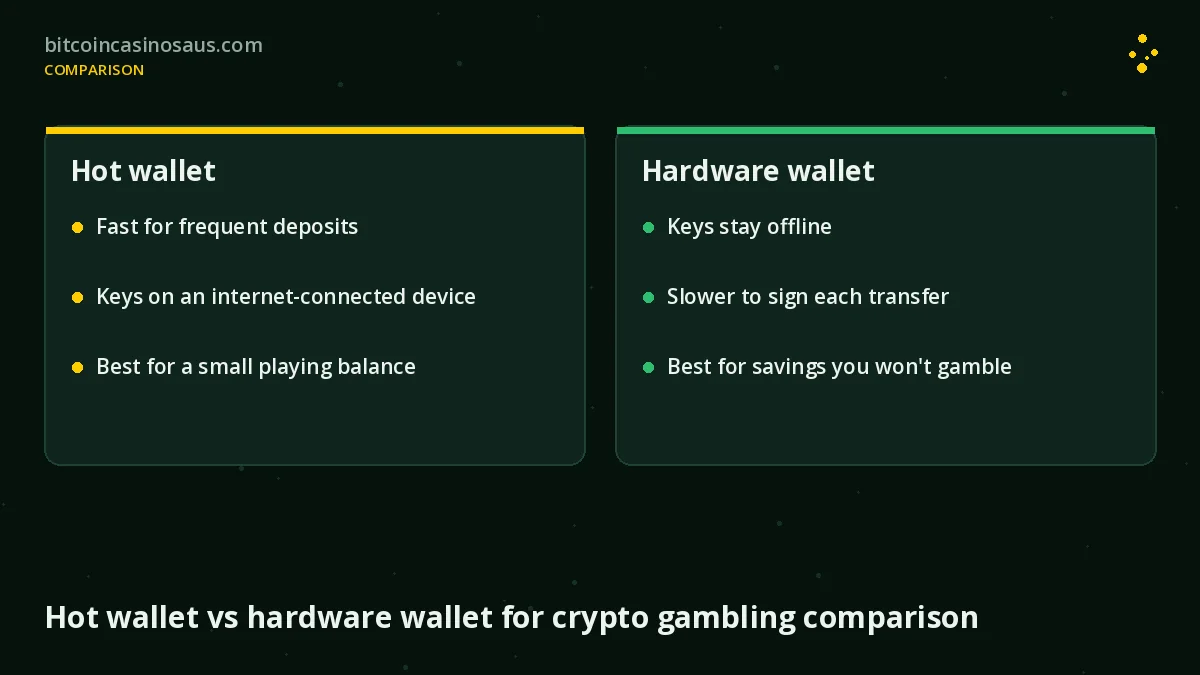
| Factor | Hot wallet (mobile or desktop app) | Hardware wallet |
|---|---|---|
| Cost | Usually free | Device purchase in A$ |
| Speed of use | Fast, phone in hand | Slower, device must be connected |
| Exposure to malware | Higher, keys live on the device | Lower, keys never leave the device |
| Lightning support | Available in many apps | Limited; usually paired with other software |
| Fit for gambling | Session funds and small deposits | Savings and larger balances |
The honest answer is that the best bitcoin wallet for online gambling is often two wallets. A hot wallet handles quick casino deposits; a hardware wallet holds the money you are not playing with.
Think of it like a wallet and a safe. You carry enough cash for the night and leave the rest at home. Once your BTC holding is larger than a few sessions' worth, a hardware wallet for savings is worth the device cost. The hot wallet then only needs topping up to your planned session budget.
Features of the Best Crypto Wallet for Gambling
Wallet reviews tend to list coin counts. When you judge the best bitcoin wallet for online gambling, five features matter more.
Fee control. You should be able to set a fee rate, or at least pick slow, normal or fast. Look for replace-by-fee (RBF), which lets you raise the fee on a transfer stuck in the mempool.
Lightning Network support. Lightning lets you pay a casino invoice in seconds for a very small fee, where the casino supports it. We cover it in its own section below.
Multi-network support. If you also use stablecoins, the wallet must handle each network separately and show which one you are sending on.
Address book with labels. Saving each casino address with a clear label stops you pasting an old or wrong address from memory.
Clear address formats. The wallet should show which Bitcoin address type you are using. Native SegWit addresses start with bc1q, Taproot with bc1p, and older formats with 1 or 3.
A wallet that hides the fee or the network is fine for buying a coffee. It is not the best crypto wallet for online gambling, where every transfer needs checking.
Wallets for Stablecoins
Many players keep a stablecoin balance alongside BTC, so their session bankroll does not move with Bitcoin's price. That changes what the wallet must do.
A TRC20 deposit at a USDT casino, for example, needs a wallet that holds both USDT and some TRX, because Tron network fees are paid in TRX. A wallet that holds only the stablecoin cannot send it.
Multi-chain wallets create a Tron address (starting with T) and an Ethereum-style address (starting with 0x) from the same recovery phrase. That is convenient, but it puts several address types side by side, so check which one you copy.
Hardware wallet support for stablecoin networks varies by device and companion app. Confirm the exact network before relying on one.
Keep stablecoins and BTC in clearly separate accounts inside the wallet, so each deposit is a deliberate choice rather than a guess.
How to Move BTC to a Casino Safely
We follow this routine for every Bitcoin deposit. It adds a few minutes and removes most of the ways a deposit goes wrong.
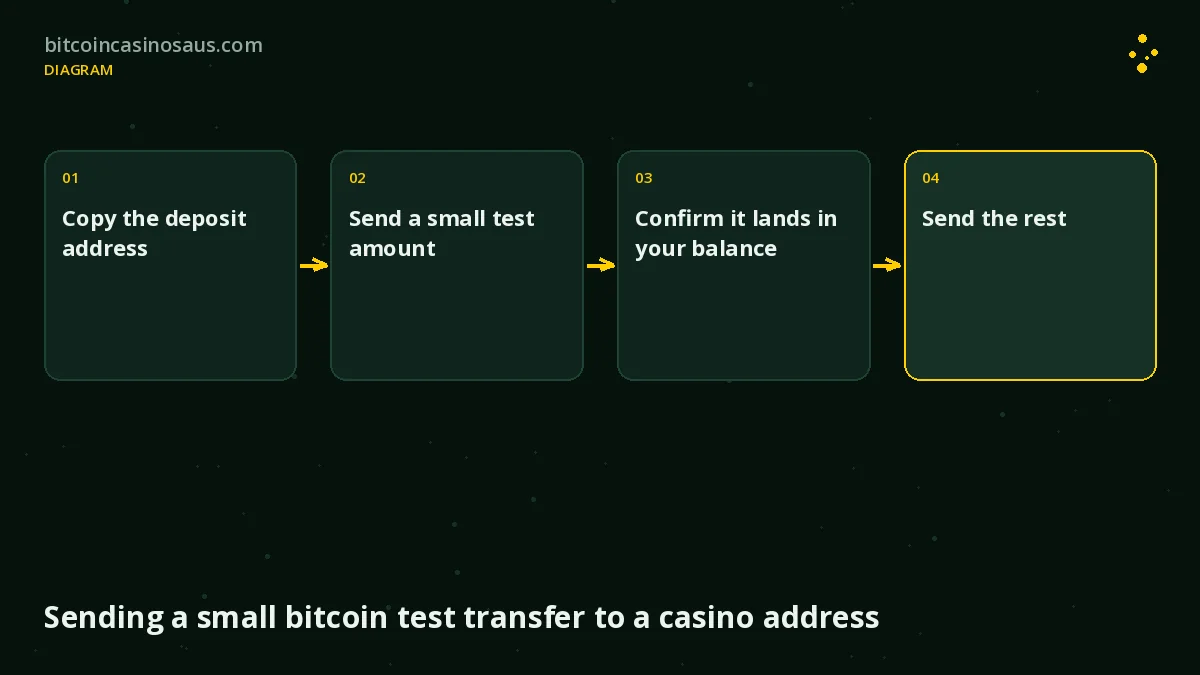
- Get the deposit address from the casino. Open the BTC deposit screen and choose on-chain or Lightning if both are offered.
- Check the casino's minimum. Note the minimum deposit so your test is large enough to be credited.
- Paste the address into your wallet, then verify it. Compare the first and last six characters with the casino screen. Clipboard malware can swap addresses.
- Set the fee. Pick a fee rate that suits how quickly you need the deposit. Check that RBF is on if your wallet offers it.
- Send a small test transfer. Send an amount just above the minimum and wait for the casino to credit it after its required network confirmations.
- Save the transaction ID. Keep the hash in case support asks for it.
- Send the main deposit. Use the same address if the casino allows reuse, or a fresh one if the screen shows a new address.
On-chain Bitcoin blocks arrive about every 10 minutes on average, and casinos usually wait for one or more network confirmations. Thrill's help centre puts Bitcoin network times at 10 to 30 minutes or more.
Wallet Privacy and Identity Checks
Bitcoin is pseudonymous, not anonymous. Every transfer sits on a public ledger, and anyone can follow it with a block explorer.
Buy BTC on an exchange that ran know your customer (KYC) checks and your identity is linked to the withdrawal address. From there, a deposit to a casino can be traced in a few hops.
Wallets can reduce casual linking. Most generate a fresh receive address for each payment, and reusing one address for everything makes your history easy to read.
Even the best crypto casinos no KYC usually keep the right to ask for ID later. Cybet states full KYC applies to large or unusual withdrawals, and Thrill's T&C 4.1 says ID can be requested at any time.
So choose the best bitcoin wallet for online gambling for control and safety, not for hiding. Plan as if ID checks at withdrawal are possible, and keep your documents ready.
Security Habits
The wallet is only as safe as the habits around it. These are the ones we treat as non-negotiable.
Recovery phrase offline. Write the phrase on paper or metal and store it somewhere private. Never photograph it, store it in cloud notes or type it into a website. No casino or support agent ever needs it.
Address whitelisting. Many exchanges let you lock withdrawals to saved addresses, sometimes with a waiting period for new ones. Turn it on, so a stolen login cannot send your BTC elsewhere.
Test transfers. Every new address gets a small test first. It costs one extra network fee and can save a whole balance.
A separate gambling wallet. Keep casino funds in their own wallet or account. A breach or a bad session then touches only that pot.
Two-factor sign-in. Use an authenticator app on exchange and casino accounts, not SMS where you have a choice.
Even the best bitcoin wallet for online gambling cannot protect a recovery phrase you typed into a website.
Using Your Wallet at an Online Casino Bitcoin Site
Once your wallet is set up, the casino side is straightforward. The details to watch are minimums, fees and where withdrawals land.
At a typical bitcoin casino Australia cashier, the deposit screen shows an address or QR code and a minimum. Cybet states a US$1 minimum deposit, while Thrill states none, so small test transfers are practical at both.
Withdrawals need a destination address from your wallet. Generate a fresh receive address, paste it, and check both ends before you confirm.
Read the casino's withdrawal fee and minimum before you play. Cybet states US$1 to 3 per withdrawal and a US$10 minimum. Thrill sets both per coin, and Cryptorino says charges can depend on the method.
Some casinos also require you to wager your deposit before withdrawing it. Cryptorino's terms say deposits must be wagered 1x first, so a deposit you change your mind about cannot leave untouched.
The best bitcoin wallet for online gambling and the right casino work as a pair, and a great wallet cannot fix a high withdrawal minimum.
Getting BTC in Australia
Most players start by buying BTC with A$ on an Australian exchange, then withdrawing it to their own wallet. The steps are simple; the costs are where care pays off.
Funding is usually by bank transfer or PayID. Some exchanges charge for card deposits, and some hold new deposits for a period before you can withdraw.
There are three costs to watch: the trading fee or spread on the purchase, the exchange's BTC withdrawal fee, and the network fee if you choose the fee yourself.
The spread is easy to miss. An "instant buy" button often quotes a worse price than the exchange's order book, and that gap is a fee.
Say you buy A$500 of BTC with a hypothetical 1% spread and a flat withdrawal fee. You lose A$5 to the spread before the withdrawal fee, so batching purchases cuts costs.
When you withdraw, check whether the exchange supports Lightning or only on-chain transfers, and which address formats it accepts. Then send a small test to your wallet first.
Buying in a few larger lots beats many small ones, and one withdrawal to your own wallet beats one for every session.
Lightning Wallets for Casino Deposits
The Lightning Network is a payment layer on top of Bitcoin. Payments move through channels rather than waiting for a block, so they usually settle in seconds with a very small fee.
At a casino, Lightning looks different from an on-chain deposit. Instead of an address, the casino shows an invoice, usually a long string starting with lnbc or a QR code. Invoices often expire after a set time and may carry a fixed amount.
Lightning wallets come in two kinds. Custodial Lightning wallets are simple but hold your funds for you. Non-custodial ones keep your keys but manage channels, which can mean an opening fee or limits on how much you can receive at first.
Cryptorino's site lists Lightning support. Cybet and Thrill do not state it, so on-chain transfers are the default there.
Lightning suits frequent small deposits, where on-chain fees would bite. For larger amounts, on-chain transfers remain the plain, well-understood option.
What to Do After a Mistaken Transfer
Mistakes happen even with good habits. What you can do depends on the kind of mistake.
Wrong address. A confirmed Bitcoin transfer to the wrong address cannot be reversed. If the address belongs to a known service, contact its support with the transaction ID; otherwise the BTC is likely lost.
Wrong network. Sending a wrapped or bridged version of BTC, or a stablecoin on the wrong chain, means the casino may not see it. Contact the casino with the transaction ID and network. Recovery depends on whether it controls that address on the other chain.
Stuck transaction. When a low-fee transfer sits unconfirmed, use RBF to raise the fee, or child-pays-for-parent (CPFP) from the receiving side where possible. With neither available, wait. Most nodes drop unconfirmed transactions after about two weeks by default, returning the coins to your wallet.
In every case, act early and keep records. Screenshots of the deposit screen and the transaction ID speed up any support request.
Picking the best bitcoin wallet for online gambling is about control: your keys, your fee, your checks. Crypto deposits land fast and stay off your bank statement, so set a session budget in A$ and keep the gambling wallet topped up only to that.
Best Bitcoin Wallet for Online Gambling FAQs
Should I gamble straight from an exchange account?
No, send BTC to your own wallet first. Exchanges often fix the fee, may question gambling transfers and can delay withdrawals, while a self-custody wallet gives you control.
Is a hardware wallet worth it for gambling?
Yes for savings, rarely for session funds. A hardware wallet keeps larger balances offline, while a hot wallet with a small top-up handles quick casino deposits more conveniently.
Does a wallet need Lightning?
Only if your casino supports it and you make frequent small deposits. Lightning settles in seconds with low fees, but many casinos do not state Lightning support, so on-chain still covers most needs.
What is a test transfer?
A test transfer is a small amount sent to a new address before the main deposit. It confirms the address and network work, costing one extra fee to protect the full balance.

Bruce Mackinley
Founder · WSOP tournament player, Melbourne
Bruce plays professional poker in WSOP tournaments, deals poker, and runs every page on this site through the same checks: published withdrawal terms, bonus fine print and what each casino's own help pages actually say.