





On this page 12 sections
- Best Crypto Casinos No KYC: What the Label Means
- When Anonymous Crypto Casinos Still Ask for ID
- What "Anonymous" Doesn't Hide
- Why Stablecoin Rails Matter for Privacy and Speed
- Keeping Your Own Keys
- Risks of the Best Anonymous Crypto Casinos for Australians
- How We Check KYC Claims in Testing
- Where No-KYC Sites Fit in the Bitcoin Casino Market
- Source-of-Funds Checks and Large Withdrawals
- Privacy Coins and Why Many Casinos Restrict Them
- What Happens to Your Balance When a Casino Demands ID Later
- No KYC Crypto Casino FAQs
"No KYC" almost always describes the sign-up form, not the cashout. That gap is where players lose access to their balance, usually at the exact moment they try to withdraw a win.
Search for the best crypto casinos no KYC and you'll find sites that let you play with an email address. Their terms tell a different story. Nearly every one keeps the right to run know your customer (KYC) checks later: ID, a selfie, proof of address, sometimes source of funds.
On this page we set out what the label really means, what triggers a check and what blockchain records still show. We also cover how to protect your balance if a casino asks for documents after you've already won.
In short
- "No KYC" usually means no documents at sign-up, while the terms still allow ID checks later.
- Large withdrawals, fraud flags and suspected bonus abuse are the common triggers for a document request.
- Bitcoin is pseudonymous, not anonymous, and every transaction sits on a public ledger.
Best Crypto Casinos No KYC: What the Label Means
At most no KYC crypto casinos, the label means one thing: you can register, deposit and play without uploading documents. ID checks are deferred, not removed.
The wording on official pages shows the pattern. Cybet asks for email confirmation to play, with full KYC kept for large or unusual withdrawals. Thrill skips KYC at registration but verifies your email before a deposit. CasinoCrypto says KYC is "not required immediately". Winna's marketing pages say "No KYC", while its terms reserve the right to request ID at any time.
So the honest description is "light ID checks at sign-up". Anyone selling the best crypto casinos no KYC as places that never ask for identity is describing a promise no terms page makes.
People searching for a crypto casino no verification or the best online crypto casino no KYC usually want two things: privacy at sign-up and a fast first withdrawal. The first is common. The second depends entirely on the terms, your withdrawal size and whether anything about your account looks unusual.
Before you sign up, find the KYC clause in the terms, not on the marketing page. Note which events it names as triggers, whether withdrawal limits change with verification level, and how long you have to reply to a request. Jack's KYC policy promises "zero unnecessary KYC roadblocks". The same policy lets it ask for ID, address, a video call or source of income at any time. HyperLucky calls itself "a no KYC crypto casino", but we could only read its pages through search-index copies, so its full terms are unconfirmed.
When Anonymous Crypto Casinos Still Ask for ID
Anonymous crypto casinos ask for documents when something about your account changes their risk. The terms usually name the triggers, and they fall into three groups.
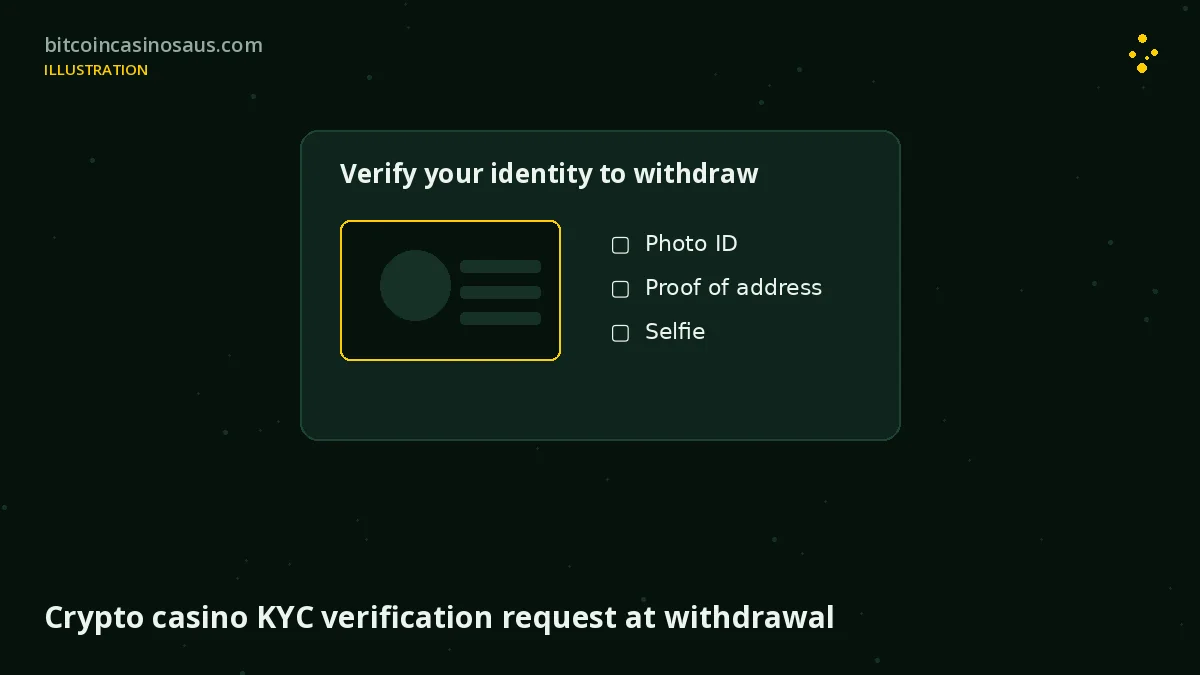
Withdrawal thresholds. Large withdrawals are the most common trigger. Cybet names "large or unusual withdrawals", and CasinoCrypto says KYC may be requested for large withdrawals. Wild.io's terms say checks may apply before the first withdrawal. Rakebit's homepage says standard withdrawals need no documents, while its terms require KYC documents on the first withdrawal.
Fraud flags. Cybet's KYC page lists repeated failed logins, IP changes and random checks as triggers. A login from a new device can be enough, and so can a password reset followed by a withdrawal request.
Bonus abuse checks. Suspected bonus abuse is a named trigger at Cybet. Casinos use ID to confirm one person holds one account. Claiming a welcome offer and withdrawing fast is a common path to a document request.
Some sites keep the right without naming triggers. Qzino's T&C 17 says checks can be requested at any time and can cover ID, a selfie, source of funds and location. Thrill's T&C 4.1 and Winna's terms say the same in fewer words.
The practical rule: when a casino can ask "at any time", assume it will ask at the worst time.
What "Anonymous" Doesn't Hide
A no-KYC casino may not hold your passport, but the blockchain holds your history. Bitcoin is pseudonymous, not anonymous. Every transaction sits on a public ledger, readable by anyone with a block explorer.
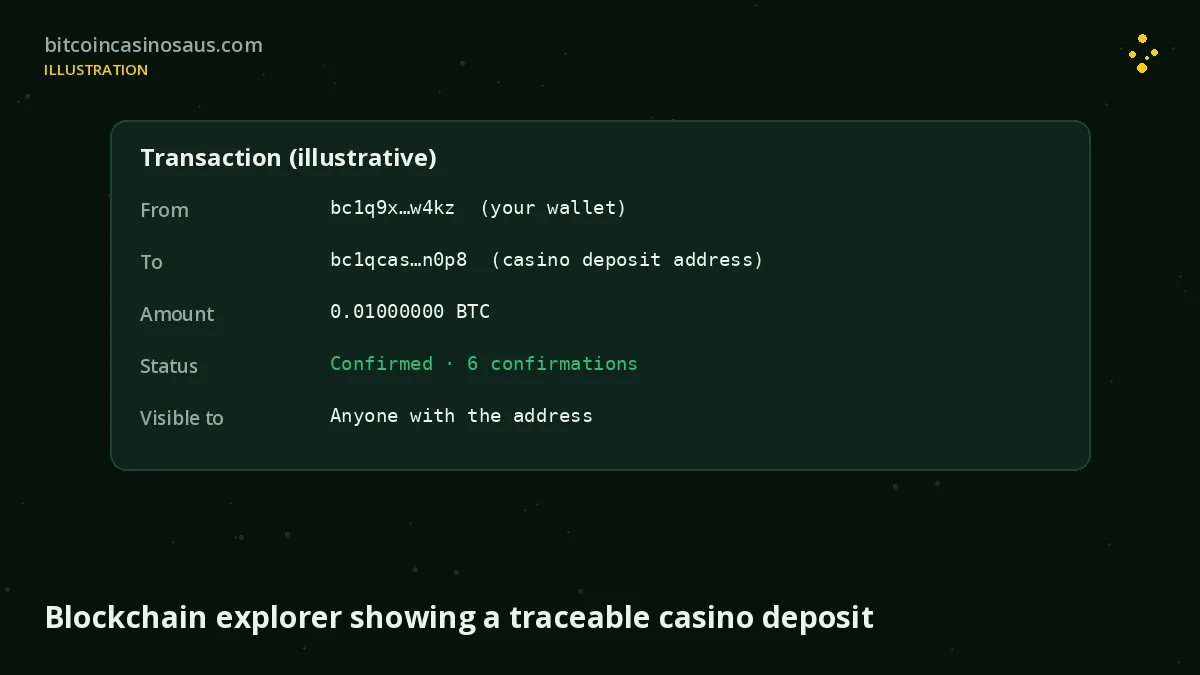
Send BTC from a wallet to a casino deposit address and the sending address, the amount and the time stay visible for good. Was that wallet funded from an exchange? Then the chain links back to an account that verified your identity. Australian exchanges ask for ID when you open an account, so most coins already have a named starting point.
Chain analysis firms group addresses that act together, and casino deposit addresses are often easy to label. Reusing one address for exchange withdrawals and casino deposits makes those links stronger.
Withdrawals work the same way in reverse. The casino's hot wallet sends coins to your address, and that payment is just as visible as your deposit. Anyone who knows one of your addresses can follow the trail in both directions.
None of this means anyone is watching your play. It means "anonymous" describes the casino's sign-up form, not your coins. True anonymity is something the network was never built to provide.
Why Stablecoin Rails Matter for Privacy and Speed
Stablecoins don't make you any more private. USDT on Tron sits on a public ledger just like Bitcoin, and Tether as issuer can freeze addresses.
Where they help is speed and cost. A TRC-20 transfer typically confirms in about a minute, and fees are usually small, though both depend on network conditions. Thrill lists a 2.5 USDT minimum and a 1 USDT fee on TRC-20 withdrawals. Winna supports USDT on ERC-20, TRC-20, SPL and BEP-20.
Speed matters at a no-KYC casino for one reason. The shorter your balance sits on the site, the less is exposed if the casino later freezes the account. A stable value also stops a pending withdrawal shrinking while a KYC request drags on for days.
Switching to stablecoins won't change what the casino can ask for, but it can change how much is caught when it does. Before you pick a USDT casino on TRC20, check that your wallet sends on the same network the deposit page shows. A wrong-network transfer is far harder to fix than any ID request.
Keeping Your Own Keys
A casino balance is custodial. The casino holds the keys, so the coins are only yours once they leave the site and land in a wallet you control.
That makes your wallet the most important privacy and safety tool you have. A self-custody wallet sits between the exchange and the casino, so you choose what moves where and keep a clean record of every transfer.
Depositing straight from an exchange account skips that layer. Your exchange then sees every casino transfer, and you depend on its withdrawal queue as well as the casino's. A wallet in the middle keeps the two separate and puts you in charge of timing.
Three habits help. Use a fresh receiving address for withdrawals where your wallet supports it. Send a small test transfer before any large deposit. Withdraw winnings promptly rather than leaving them in the casino lobby.
Choosing the best bitcoin wallet for online gambling comes down to network support, fee control and an address book you trust. Lightning support helps too, since Cryptorino is the only one of our 11 brands that states it accepts Lightning.
Risks of the Best Anonymous Crypto Casinos for Australians
The risk with the best anonymous crypto casinos isn't being identified. It's having no one to turn to when the casino keeps your money.
Frozen balances. Cryptorino's terms let it hold withdrawals until identity is verified. Can't or won't provide documents? The balance stays put.
Long timelines. Qzino gives players 7 days to reply to a KYC request and takes up to 30 days to finish it. Wins of US$50,000 or more may then be paid in instalments over 30 days.
Contradictory pages. Rakebit's homepage and terms disagree on KYC and on withdrawal limits. When pages conflict, the terms win, and the terms are rarely the generous version.
Account closure. Most terms let a casino close an account that fails a check. Deposits may be returned, but winnings, and especially bonus winnings, can be voided.
No recourse. These are offshore businesses. If a dispute stalls, outside help is limited to complaint mediators and public pressure, and none of them can force a payout.
The pattern behind the best crypto casinos no KYC is simple: the less a site checks at the door, the more it can check at the exit.
How We Check KYC Claims in Testing
Every no-KYC claim gets tested against the terms and a real withdrawal. We record what the sign-up form asks for, then read the KYC clause line by line and list every named trigger.
Live chat gets a direct question: what would trigger verification on this account? A clear answer that matches the terms counts in the site's favour. A vague one, or an answer that contradicts the terms, goes in the review.
Next we compare the marketing copy with the terms. Winna's "No KYC" against its ID clause is a typical result, and we print both.
Then we withdraw. A small test balance tells us whether ID was requested, at what step, and how long the payout took: Test log pending: date, coin, network, amount in A$, network fee, time to land, KYC requested yes or no.
Small amounts rarely hit large-withdrawal checks, so we never claim a site "never asks". The same caveat runs through our crypto casino reviews, and every claim about the best crypto casinos no KYC on this page is tied to a dated terms clause.
Where No-KYC Sites Fit in the Bitcoin Casino Market
The line between a no-KYC casino and a regular crypto casino is mostly about timing. Almost every site in the market now lets you register with an email address and checks identity later, if at all.
Some brands simply say it more loudly. HyperLucky puts "no KYC" in its own description, Jack talks about avoiding "unnecessary" checks, and Cybet asks for email only. Read side by side, their terms look far more alike than their marketing does.
That shifts the useful question. It isn't whether a site does ID checks, but when, why and with what limits. CasinoCrypto ties weekly withdrawal limits of US$5,000 to US$25,000 to verification and VIP level, which tells you more than any badge.
At any bitcoin casino Australia site you shortlist, read the KYC clause next to the withdrawal limits. The two are usually linked, and together they show how far a "no verification" promise really goes.
That's also why the best crypto casinos no KYC aren't a separate category in our ratings. They're scored on the same payout, terms and support criteria as every other site, with the KYC clause read as part of the terms.
Source-of-Funds Checks and Large Withdrawals
Source-of-funds checks go further than ID. They ask where the money came from, and they tend to arrive with large withdrawals.
Qzino lists source of funds among its KYC requests. Jack's KYC policy lists source of income. Cybet names large or unusual withdrawals as a full-KYC trigger.
What counts as proof varies. Expect exchange statements showing the purchase, wallet history linking the exchange to the casino deposit, and sometimes payslips. Players who bought BTC on an Australian exchange and moved it through one wallet have the easiest time.
Keep records from day one: exchange trade confirmations, wallet transaction IDs and screenshots of deposits. A tidy paper trail turns a week-long check into a short one.
Send what's asked for in the format requested: clear colour scans, every corner visible, and statements that show your name. Partial uploads usually restart the clock.
Privacy Coins and Why Many Casinos Restrict Them
Privacy coins hide amounts and addresses on their own chains, so casinos find them harder to trace for fraud checks. That makes them rare on payment pages.
Of our 11 brands, only two list them. Rakebit includes XMR and ZEC, and Jack includes XMR and DASH. The rest publish no privacy coins at all.
Liquidity is the other reason. Fewer exchanges list privacy coins, so casinos struggle to convert them. Qzino's T&C 9.10 says low-liquidity coins may be converted to USDT, which shows how casinos handle coins they can't easily hold.
Some sites also convert or refuse coins they don't list. Sending an unlisted coin to a deposit address can mean a support ticket at best and lost funds at worst, so check the payment page every time.
A privacy coin deposit doesn't change the KYC clause either. The casino can still ask for ID at withdrawal, whatever coin you used.
What Happens to Your Balance When a Casino Demands ID Later
When a casino asks for documents after you've won, your balance usually stays frozen until the check is done. Some sites let you keep playing, but you can't withdraw.
Timelines matter. Qzino's 7-day reply window and 30-day completion period are typical of how long a balance can sit. Miss the reply window and the terms usually allow the account to be closed.
Bonus winnings are most at risk. Where the check is about suspected bonus abuse, the terms can void the winnings while still returning the deposit.
When a request arrives, reply inside the window, ask support for the full list of documents in writing, and save the chat transcript. Ask, too, whether the request covers your whole balance or only one withdrawal.
Protect yourself before it happens:
- Have ID and proof of address ready, even at the best crypto casinos no KYC lists recommend.
- Withdraw regularly instead of letting a large balance build.
- Use the same wallet for deposits and withdrawals.
- Save the terms version that applied when you signed up.
A crypto balance reloads in under a minute and never shows on a bank statement, so set a deposit limit in A$ before you fund any account.
No KYC Crypto Casino FAQs
Do no KYC casinos have lower withdrawal limits?
Often yes, because limits can rise with verification. CasinoCrypto, for example, ties weekly limits of US$5,000 to US$25,000 to verification and VIP level. Read the limits clause next to the KYC clause, because an unverified account may sit on the lowest tier.
Can a no KYC casino freeze my withdrawal?
Yes, most terms let a casino hold a withdrawal until ID is verified. Cryptorino's terms say exactly that, and Qzino allows up to 30 days to complete a check. Withdrawing regularly limits how much can be caught, and replying inside the stated window keeps the account open.
Is bitcoin anonymous?
No, Bitcoin is pseudonymous: every transaction is public on the blockchain. If your coins came from an exchange that verified your identity, the chain can link back to that account. Reusing addresses makes those links easier to follow.
What triggers a KYC check?
Large or unusual withdrawals, fraud flags such as repeated failed logins or IP changes, and suspected bonus abuse are the common triggers. Many terms also allow checks at any time, with no reason given, so keep ID ready even at the best crypto casinos no KYC lists name.

Bruce Mackinley
Founder · WSOP tournament player, Melbourne
Bruce plays professional poker in WSOP tournaments, deals poker, and runs every page on this site through the same checks: published withdrawal terms, bonus fine print and what each casino's own help pages actually say.