





On this page 13 sections
- What a USDT Casino Is and Why Players Use Tether
- USDT TRC20 Casino Transfers vs ERC20 and BEP20
- How to Send USDT to a Casino Safely
- The Wrong-Network Mistake and How to Avoid It
- TRON Energy and Bandwidth Fees
- USDT vs Bitcoin for Casino Play
- Wallets That Hold TRC20 USDT
- Stablecoins and Identity Checks
- USDT Deposit and Withdrawal Limits at Casinos
- Tether-Specific Risks
- Converting USDT to AUD
- Other Stablecoins You May See (USDC) and How They Compare
- USDT Casino FAQs
The quickest way to lose a USDT casino deposit is not a bad bet. It's picking the wrong network in a dropdown, and a support ticket cannot always reverse that.
Tether (USDT) is the stablecoin you will see most often at crypto casinos. It fixes one real problem: your balance holds its value in US dollar terms while you play. It also brings new ones, from network fees paid in a second coin to an issuer that can freeze addresses.
Below we compare TRC-20, ERC-20 and BEP-20 transfers and list the USDT networks each brand's own site names. We also show the checks we run before any USDT casino gets a cent. Fee and speed figures are ranges, because both move with network conditions.
In short
- TRC-20 is the default at almost every USDT casino because fees stay low and blocks arrive every few seconds.
- BEP-20 and ERC-20 share the 0x address format, which causes more lost deposits than any other mix-up.
- A USDT balance tracks the US dollar, so your A$ result still depends on the exchange rate.
What a USDT Casino Is and Why Players Use Tether
A USDT casino is any crypto casino that accepts Tether for deposits and withdrawals, usually holding your balance in USDT. Tether is designed to track the US dollar one to one, and the same token exists on several blockchains at once.
USDT on Tron, Ethereum and BNB Chain is the same asset in value, but each is a separate token that cannot jump chains by itself.
Players pick USDT for three plain reasons. The balance does not swing with the crypto market, Tron transfers are cheap, and nearly every exchange lists it. No surprise, then, that USDT casinos have spread so quickly.
Bitcoin can move several percent in an afternoon. Deposit 0.01 BTC, watch the price drop before you cash out, and you can win a session yet still lose money in dollar terms. A USDT casino balance removes that variable.
There is one catch for Australian players. A USDT balance is a US dollar balance, so your A$ result still depends on the exchange rate when you convert back. That currency risk is smaller and slower than Bitcoin's price swings, and an acceptable trade for most bankrolls.
| Brand | USDT networks listed on the brand's site | Other stated USDT or payment detail |
|---|---|---|
| Rakebit | TRC-20, BEP-20, ERC-20, Solana, TON | Payment table: 20 USDT minimum deposit, 40 USDT minimum withdrawal |
| Thrill | ERC-20, TRC-20, BEP-20, Solana, Polygon | No minimum deposit; TRC-20 withdrawal minimum 2.5 USDT, fee 1 USDT |
| Wild.io | ERC-20, TRC-20, BEP-20, Solana | Withdrawal minimum about 5 USDT |
| Winna | ERC-20, TRC-20, Solana (SPL), BEP-20 | Minimum deposit US$5, minimum withdrawal US$20 |
| CasinoCrypto | Not stated | No casino withdrawal fees (network fees apply) |
| Cybet | Not stated | Minimum deposit US$1, minimum withdrawal US$10, fee US$1 to 3 |
Before you sign up, open the deposit screen and confirm the network list yourself. Where a brand's site does not state its networks, the deposit page is the only reliable source, and it can change without notice.
USDT TRC20 Casino Transfers vs ERC20 and BEP20
The network you choose decides what you pay, which coin pays it, and what the address looks like.
| Network | Blockchain | Address starts with | Fee paid in | Typical fee level | Typical speed |
|---|---|---|---|---|---|
| TRC-20 | Tron | T (34 characters) | TRX (energy and bandwidth) | Low; a few TRX without staked energy, close to nothing with enough energy | Blocks about every 3 seconds; credit after the casino's required network confirmations, usually minutes |
| ERC-20 | Ethereum | 0x (42 characters) | ETH (gas) | Varies most: cents when quiet, several US$ or more when busy | Blocks about every 12 seconds; usually minutes |
| BEP-20 | BNB Chain | 0x (42 characters) | BNB (gas) | Usually cents | Fast blocks; usually minutes |
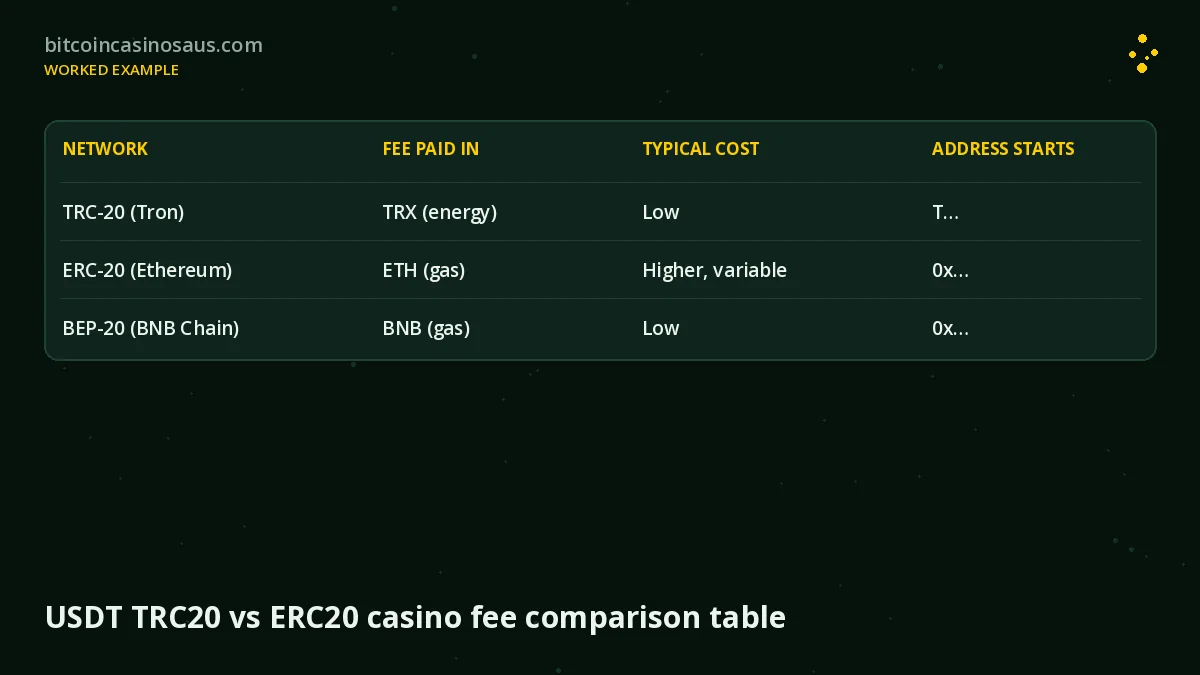
TRC-20 is the default at almost every USDT casino for a reason. Fees stay low, blocks arrive every few seconds, and Tron carries a large share of all USDT transfers.
ERC-20 has the widest wallet support and the deepest exchange liquidity. Its weakness is cost: Ethereum gas rises sharply when the network is busy, and a fixed fee hurts most on small deposits.
BEP-20 is cheap and quick, but it shares the 0x address format with Ethereum. That overlap causes more lost deposits than any other mix-up, and we cover it below.
Network fees are only half the bill. The casino may also charge its own withdrawal fee, such as Thrill's stated 1 USDT on TRC-20 withdrawals or Cybet's stated US$1 to 3.
A good USDT TRC20 casino states its withdrawal fee per network before you ask.
How to Send USDT to a Casino Safely
Most failed USDT casino deposits come from skipping one of these steps.
- Check the USDT casino's network list. Open the deposit screen and note which networks it accepts. Do not assume TRC-20 is there.
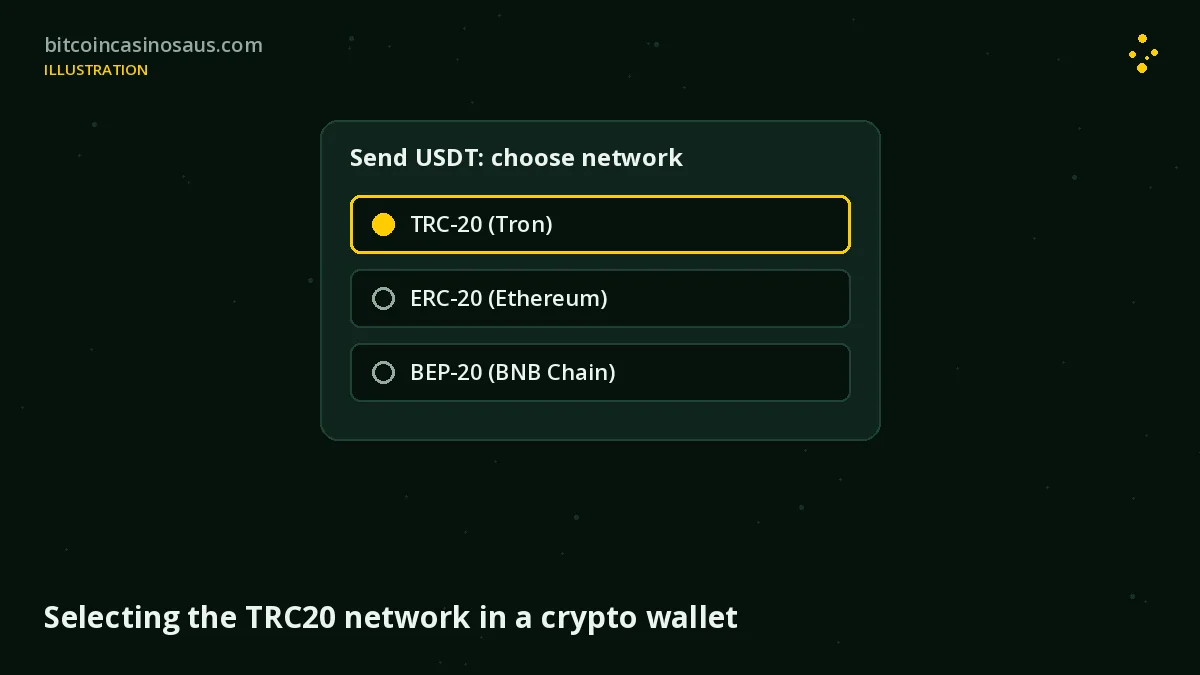
- Select the same network in your wallet. Your wallet or exchange withdrawal form must show the exact same network: TRC-20 to TRC-20, BEP-20 to BEP-20.
- Copy the address, then verify it. Paste it, then check the first and last six characters against the casino screen. A Tron address starts with T; Ethereum and BNB Chain addresses start with 0x.
- Hold the fee coin. Keep some TRX for TRC-20, ETH for ERC-20 or BNB for BEP-20 in the sending wallet. Without it, the transfer will not go.
- Send a small test first. Send an amount just above the casino's stated minimum and wait for it to appear in your balance.
- Save the transaction ID. Copy the hash from your wallet. Support needs it if the credit is late.
- Send the rest. Once the test lands, send the main deposit to the same address on the same network.
Clipboard malware that swaps copied addresses exists, which is why step 3 checks both ends of the address.
The Wrong-Network Mistake and How to Avoid It
A Tron address field will usually reject an 0x address, so TRC-20 errors are less common than people fear. The real danger sits between ERC-20 and BEP-20.
Because both chains use the same address format, a wallet will happily send BEP-20 USDT to an address the casino only watches on Ethereum. The tokens arrive on BNB Chain at that address, and the casino's system never sees them.
Whether you get them back depends on the USDT casino. If it controls the same key on BNB Chain, support may recover the funds, often for a fee and after a wait. If it does not, the USDT can be stuck for good.
A second trap: some casinos issue separate Tron addresses for TRX and USDT, and USDT sent to the TRX address can go uncredited.
Exchanges add a third risk: some pre-select a default withdrawal network that your USDT casino may not accept.
Treat the network dropdown as the most important field on the screen. Save each casino address in your wallet's address book with the network in the label, such as "Casino A, USDT TRC-20".
TRON Energy and Bandwidth Fees
Tron does not charge a simple per-transfer fee. It uses two resources: bandwidth, which covers the size of a transaction, and energy, which covers smart-contract work.
A TRC-20 USDT transfer is a smart-contract call, so it needs energy. If your account has none, the network burns TRX from your balance to cover the cost.
Each account gets a small free daily bandwidth allowance, but no free energy. That is why a wallet holding only USDT cannot send it.
Staking TRX gives your account a daily energy allowance, and some services rent energy for a single transfer. Casual players usually keep a small TRX buffer and let the network burn it.
The cost also depends on the recipient. Sending USDT to an address that has never held it uses roughly twice the energy of sending to one that already does, so first deposits can cost more.
Here is where "best tron casino" claims should be tested. The best tron casino is not the one with the loudest banner. It's one that pays withdrawals on TRC-20 and publishes the fee per network. Six of the brands on this page list TRX itself as a deposit coin too.
USDT vs Bitcoin for Casino Play
Neither coin wins on every count at a USDT casino. Choose based on whether price stability or Bitcoin's wider support matters more.
| Factor | USDT (TRC-20) | Bitcoin (on-chain) |
|---|---|---|
| Price movement | Tracks the US dollar | Can move several percent in a day |
| Typical network fee | Low, paid in TRX | Varies with mempool demand |
| Block time | About 3 seconds | About 10 minutes on average |
| Second coin needed | Yes, TRX for fees | No |
| Issuer risk | Yes, Tether can freeze addresses | No issuer |
Thrill's help centre puts Bitcoin network times at 10 to 30 minutes or more, against under a minute for Solana.
Bitcoin still has strengths: no issuer, no second fee coin, and the Lightning Network for fast small payments where a casino supports it.
Play mostly at a bitcoin casino Australia site and treat BTC as a long-term holding? Then a separate USDT balance for sessions is a sensible split. You stop mixing price speculation with game results.
Wallets That Hold TRC20 USDT
For TRC-20, your wallet must hold two things: the USDT itself and enough TRX to pay energy.
The best bitcoin wallet for online gambling also lets you choose the network on every send, stores labelled addresses and shows the fee before you confirm.
Multi-chain self-custody wallets create a Tron address and an 0x address from the same recovery phrase, so check which one you are copying.
Hardware wallets such as Ledger or Trezor keep keys offline, but Tron support varies by device and companion app. Confirm Tron and TRC-20 support before you rely on one for casino transfers.
An exchange account is fine for buying USDT, but a self-custody wallet should sit between the exchange and the USDT casino, leaving one less party able to block a transfer.
Stablecoins and Identity Checks
Tether is not private. Every USDT transfer on Tron, Ethereum or BNB Chain sits on a public ledger that anyone can search with a block explorer.
Players shortlisting the best crypto casinos no KYC often assume a stablecoin hides them. It does not. Buy USDT on an exchange that ran know your customer (KYC) checks, and anyone with both records can link your account to your casino address.
Casinos also keep the right to ask for ID. Wild.io's terms say KYC can be requested at any time, Thrill's T&C 4.1 says the same, and CasinoCrypto says it may ask on large withdrawals.
Cybet states that full KYC applies only to large or unusual withdrawals and a few other triggers. A narrower rule is still not a promise of anonymity, so plan as if ID checks at withdrawal are possible at any USDT casino and keep documents ready.
USDT Deposit and Withdrawal Limits at Casinos
Minimums at each USDT casino differ more than most players expect. Thrill states no minimum deposit, Cybet states US$1, and Rakebit's payment table lists 20 USDT.
Withdrawal minimums are the ones that bite on small balances. Thrill states 2.5 USDT on TRC-20, Wild.io about 5 USDT, Cybet US$10, Winna US$20 and Rakebit 40 USDT in its payment table.
Maximums matter on a big win. Wild.io caps withdrawals at US$100,000 per 7 days and US$200,000 per 30 days, while CasinoCrypto lists weekly limits of US$5,000 to 25,000 depending on verification and VIP level.
Cybet sets no total cap but limits a single win to US$100,000 per transaction. Thrill states no withdrawal maximum at all.
Watch for deposit turnover, the rule that you must wager your own deposit before withdrawing it. CasinoCrypto states that deposits are wagered 2x before withdrawal.
Say you deposit 100 USDT at a 2x deposit turnover. You need to place 200 USDT in bets before that deposit can leave, even if you never take a bonus.
Tether-Specific Risks
Every USDT casino balance depends on one company, Tether, keeping the token worth a dollar. Three risks are worth knowing.
Depeg events. USDT has traded briefly below US$1 during market stress, including in May 2022, before recovering. A short dip during a withdrawal could cost you a few cents per token.
Address freezes. Tether's token contracts let the issuer freeze USDT at specific addresses, and it has frozen funds tied to hacks and scams. A frozen USDT casino hot wallet would delay payments for every player using it.
Issuer controls. Tether decides which blockchains it supports, and it has wound down USDT on several smaller chains in recent years. Stick to the major networks if you want long-term support.
Tether publishes reserve reports on tether.to, but read them as the issuer's own disclosures, not a guarantee. Hold only your session bankroll in USDT on a casino balance. Anything larger belongs in your own wallet or converted back to A$.
Converting USDT to AUD
When you cash out of a USDT casino, the last step is turning USDT back into Australian dollars. Small costs add up here.
Most large Australian exchanges list a USDT/AUD market. Before you send, check that the exchange accepts USDT deposits on the network you plan to use, because some only accept ERC-20 or a limited set.
Compare three costs: the network fee to send USDT to the exchange, the trading fee or spread on the sale, and any fee to withdraw A$ to your bank.
The spread is the one people miss. An "instant sell" button often quotes a worse price than the order book, and that gap is a fee in all but name.
Say you sell 1,000 USDT at a hypothetical rate of A$1.50 per USDT. You get A$1,500 before costs, and a 1% spread takes A$15 of it.
Timing matters too. Should the Australian dollar strengthen between your win and your sale, the same 1,000 USDT buys fewer A$.
Compare the quoted price with the order book before every sale, and use the order book when the gap is wide. Most exchanges pay A$ out by bank transfer or PayID, so check which one is cheaper on your account.
Other Stablecoins You May See (USDC) and How They Compare
USDC, issued by Circle, is the main alternative to USDT. Cybet, Rakebit, Thrill, Wild.io, Winna and CasinoCrypto all list it among their accepted coins.
Rakebit states USDC on the same networks it lists for USDT; the others do not name their USDC networks.
One practical difference: Circle stopped supporting USDC on Tron in 2024. That means USDC transfers usually run on Ethereum, Solana or other chains, not on the cheap Tron route most players use for USDT.
You may also see DAI (Rakebit, Thrill, Winna) or EURC and USDG (CasinoCrypto). Fewer exchanges offer cheap A$ exits for these.
For most players at a tether casino, USDT on TRC-20 stays the cheapest route. USDC makes sense if you already hold it or prefer its issuer, but it rarely saves fees at a USDT casino that also takes it.
Picking the best USDT casino comes down to networks, fees and limits stated in writing, not the size of the offer. A USDT casino balance reloads in under a minute, so set a deposit limit in A$ before you start and stick to it.
USDT Casino FAQs
Is TRC20 or ERC20 better for a USDT casino?
TRC-20 is usually better for casino deposits because fees are lower and blocks are faster. ERC-20 suits players whose wallet or exchange only supports Ethereum, but its gas costs rise when the network is busy.
What happens if I send USDT on the wrong network?
The USDT usually arrives on the other chain at the same address, but the casino may not see or credit it. Recovery depends on whether the casino controls that address on the other network and agrees to help, often for a fee.
Are USDT casino withdrawals faster than bitcoin?
On-chain, yes: Tron blocks arrive about every 3 seconds, against about 10 minutes for Bitcoin. The casino's own approval time still decides when the money actually leaves, and that varies by brand.
Is USDT safe to hold?
USDT is stable in normal markets but carries issuer risk. Tether can freeze addresses, and the token has briefly traded below US$1 during stress, so hold only what you need for play on a USDT casino balance.

Bruce Mackinley
Founder · WSOP tournament player, Melbourne
Bruce plays professional poker in WSOP tournaments, deals poker, and runs every page on this site through the same checks: published withdrawal terms, bonus fine print and what each casino's own help pages actually say.